
What hypopressives are, and what isn't one even if it's called that
Sucking your stomach in and flaring your ribs is not a hypopressive. What defines the technique isn't the posture you see: it's what happens next, and it happens on its own.
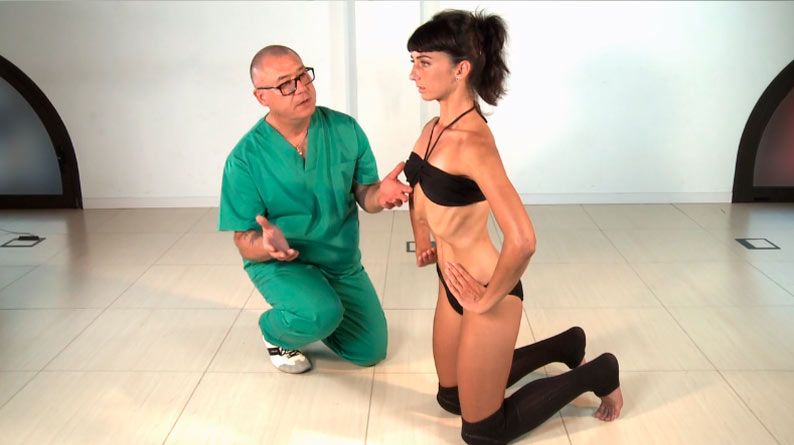
The name travels faster than the method
You walk into the class. They tell you to breathe all the air out, hold without breathing and pull your stomach in until your ribs show. Count to ten. Repeat six times. Nobody has asked how you breathe, or about your neck, or looked at your posture before starting.
A month later you see the same exercise in a thirty-second video, explained backwards. And the centre next door calls it the same thing but teaches it another way. Everyone says «hypopressives».
If you work with patients, the scene is worse from the other side: someone arrives saying they already tried hypopressives and they didn't work for them. And when you ask what exactly they did, you find out they never did hypopressives.
Anyone can use the word. The method is another matter
What a hypopressive actually is
A hypopressive is, by definition, a technique that does not increase thoracic or abdominal pressure. Hence the name: hypo-pressive, less pressure. It is exactly the opposite of what a classic abdominal exercise does, pushing the viscera down and forward.
The mechanism is not in the abdominal muscle. It is in the diaphragm. The posture and the expiratory apnoea produce a tonic relaxation of the thoracic diaphragm: a drop in the activity of its small postural muscle fibres, the type I fibres. The diaphragm stops pushing.
From there a chain of reflex neurological reactions unfolds, which Dr Marcel Caufriez named divergences. They are the ones responsible for the effects, not you: among others, the reflex contraction of the abdominal muscles and of the muscles of the perineum.
That is the line separating a hypopressive from everything else. You don't perform the contraction: you trigger it. If you tighten your abdomen at will, you have done another exercise — possibly a good one — but not a hypopressive.
The term was coined by Caufriez himself in the nineteen-eighties, to name a type of postural exercise that did not exist until then. That word had never been used for an exercise before.
You don't perform the contraction: you trigger it
What a hypopressive is not
These four claims circulate daily, and all four are false.
They do not come from yoga. The method was born in a hospital setting, researching urogynaecological dysfunction, not in a postural tradition. What it shares with yoga is working in postures and with the breath; the resemblance ends there.
They have nothing to do with bodybuilding. Caufriez calls that claim completely wrong and absurd from a physiological, biochemical and biomechanical point of view. This is not a difference of schools: the aim, the mechanism and the effect run in different directions.
They are not the abdominal vacuum. The bodybuilder's stomach vacuum is a voluntary suction held by the musculature. A hypopressive is a posture and an apnoea that trigger a reflex response. In a photograph they can look identical; in mechanism they are opposites. The confusion has travelled far: the British Journal of Sports Medicine itself once treated them as equivalent in one of its publications.
It is not «opening the rib cage». Costal opening is something observed during the expiratory apnoea, not the definition nor the goal. Turning a visible effect into the instruction for the exercise means keeping the part you can see and losing the part that does the work.
And, in case it needs saying: it is not sucking your stomach in either.
They look alike in a photo and are opposites in mechanism
It is not a single exercise: it is a method with three families of techniques
When someone says «hypopressives» they almost always mean just one of the three families that make up the method.
Hypopressive gymnastics is the best known, and it isn't even a closed routine. The base programme is 14 exercises and 70 different postures. The static programme is 22 exercises and more than 120 postures. The dynamic programmes go beyond 800.
The diaphragmatic aspiration techniques are applied with manual or instrumental therapy, and target functional injuries.
The tensional transfer techniques, the T.T.T., are applied at the cervico-cephalic level and address postural and emotional deficit.
All three share one condition, written in these words in the method's official documentation: for safety reasons, all these techniques must be carried out under the supervision of a health professional holding a specialist certificate in hypopressive techniques.
That is why a stand-alone video cannot be the method. Not because it lacks information, but because it lacks the one thing that decides which exercise is right for you.
A video can teach you a posture. It cannot decide whether it suits you
How to tell whether what you're doing is the method
You don't need to be a specialist to tell the difference. Five things are enough.
- You are assessed before you start. Postural, respiratory, joint and morphological tests, with their exclusion criteria. If nobody has assessed you, nobody knows which exercise is right for you.
- Whoever teaches it has prior training related to health. It is the requirement Caufriez Concept® repeats: to take a training course in which you will afterwards work with people's health, you need a foundation training related to health.
- There is a certificate and it is known who issues it. A programme with traceability can say where it comes from, who signs it and what level it corresponds to. One without it cannot.
- There is progression, not a repertoire. The method has an algorithm that orders the decision: which exercise, at what point and why. It is not a list of postures to try out.
- You are asked about your history. Some situations are approached with caution — cervical hernias, for instance, where there is not enough evidence — and that can only be taken into account if somebody asks first.
Caufriez Concept® tells of a patient who flatly refused to do hypopressives. She had done them with someone without the proper training and concluded they don't work. She accepted them later, with a certified therapist, once the difference was explained to her.
That is the real price of the confusion. When something goes wrong, the one that loses its name is the method.
If nobody has assessed you, nobody knows which exercise is right for you
Forty years of history you can actually check
The Hypopressive Method did not come out of a training trend. It came out of clinical research. Dr Marcel Caufriez, a rehabilitation specialist and PhD in Motor Sciences from the Université Libre de Bruxelles, developed assessment and treatment tools for urogynaecological dysfunction in the nineteen-eighties, working in hospitals such as the Erasme in Brussels with the support of physiology laboratories.
Out of that work came perineal tonimetry and its instruments, the diaphragmatic aspiration techniques and hypopressive abdominal gymnastics. He has been publishing books since 1984. Before 1990 the method was already taught in Belgian and European universities, and in 1997 it reached Spain through the University of Castilla-La Mancha and Universitat Gimbernat.
None of that is brand storytelling: they are dates, institutions and publications that can be checked one by one. It is precisely what a free-form version of the method cannot show you.
- Born in the hospital, not the gym Urogynaecology, a physiology laboratory and instrumental assessment. The exercise came after the assessment, not the other way round.
- Assessment before prescription Tests, exclusion criteria and an algorithm that orders the decision. The exercise is chosen from what has been measured in each person.
- It has a signature and a level The Caufriez Concept® certification states where the programme comes from and what it accredits. It can be traced back to its origin.
Learn the method with no version in between
The Hypopressive Abdominal Gymnastics training at Hipopresivos Online is the only 100% online course taught by Dr Caufriez himself, with Caufriez Concept® certification. For health and sport professionals.
See the training